

2/6
A Brief History of Broadcasting the FIFA World Cup™
Jenny breaks down FIFA World Cup™ broadcasts and their evolution from radio to immersive digital experiences.
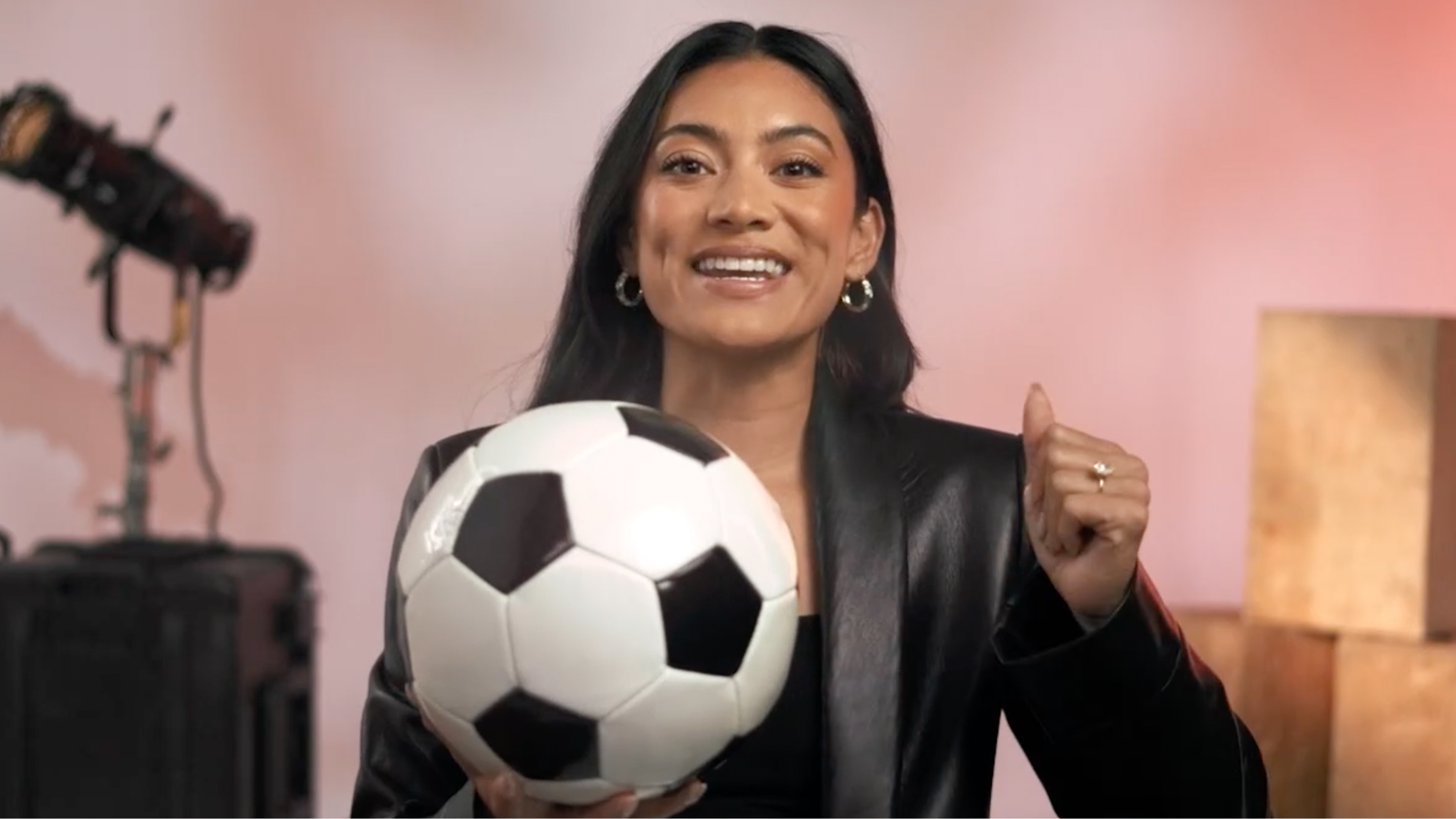
- FIFA World Cup™ is the biggest sporting event on the planet.
And the 2026 tournament will be the biggest one yet.
With 48 teams competing across three separate countries,
it'll be live in just about every nation on Earth
and watched by billions.
That's massive.
But it's funny to think it wasn't always like this.
In this section, I'll take you through the history of how FIFA World Cup™
has been delivered to fans worldwide
and how it grew to become the global phenomenon it is today.
Sports have always been at the forefront of media technology,
from newspaper, to radio, to TV, and the internet.
And up until 1970, most people weren't able to watch the FIFA World Cup™ on TV.
If you were interested enough, you'd listen on the radio if you were lucky,
or read about it in the paper the next day.
That all changed in a major way
at the 1970 FIFA World Cup™ in Mexico,
where football was ready for its closeup.
Literally, the ball that you probably think of when you picture a soccer ball
made its debut in 1970.
It's called the adidas Telstar.
And its black and white contrasted panels were designed to show up clearly
on the low-resolution televisions of the time.
So many people watch that tournament
that the common idea of a soccer ball design has been based on that first impression ever since.
That's just one example of how much impact global broadcast can have on its viewers.
Well, soccer was already here, but the summer of 1994,
it really took off in America.
Stadiums were packed across the 52 matches,
and the final drew over 94,000 at the Rose Bowl.
For supporters that couldn't get there in person, matches were broadcast on TV as well,
drawing more than 145 million viewers stateside.
It was a huge moment, which led directly to the formation of Major League Soccer
to capture the momentum and push soccer even further forward.
Could you imagine the FIFA World Cup™ without social media?
We've come to think of the second screen as part of the viewing experience.
That's anything that happens on your phone as you watch,
chatter on social media, instant highlights,
funny memes and moments from fans in the stands.
Well, 2014 was a big turning point in sport and social media.
Three billion, with a B, supporters checked in on Facebook and Twitter
as they reacted in real time with what was going on on the pitch.
Not to mention how brands were engaging too.
Another fun wrinkle was it made communication work two ways
so athletes could react back to fans in the moment.
A great example of this digital interactivity made its way to the actual field.
Coca‑Cola created the Happiness Flag,
where users were encouraged to submit selfie photos
through Facebook, Twitter, Instagram, and more.
Coca‑Cola then used them to create the largest photo mosaic ever,
dubbed the Happiness Flag.
More than 220,000 images were used to create a mosaic
that was unveiled on the field before the first match.
Technology in Qatar blew the minds of fans around the world,
with VR experiences, second screens brought the game even closer.
Each tournament, even the ones we didn't cover,
mirrors the way people connect at the time,
radio, then TV, then social, then immersive digital.
Delivering the game to the world isn't just one thing,
it's always evolving based on how people consume stories.
Media didn't just show the matches, it helped build global soccer culture
and made it a communal experience that expanded well beyond the borders of the stadium.
Social media made every supporter a storyteller,
and 2014 marked the first true two-way FIFA World Cup™.
This wasn't just broadcasting a game, it was co-creating the experience.
That shift changed everything.
In fact, you'll hear more about storytelling in the next section.